Dr. Dunbar's Bite Scale
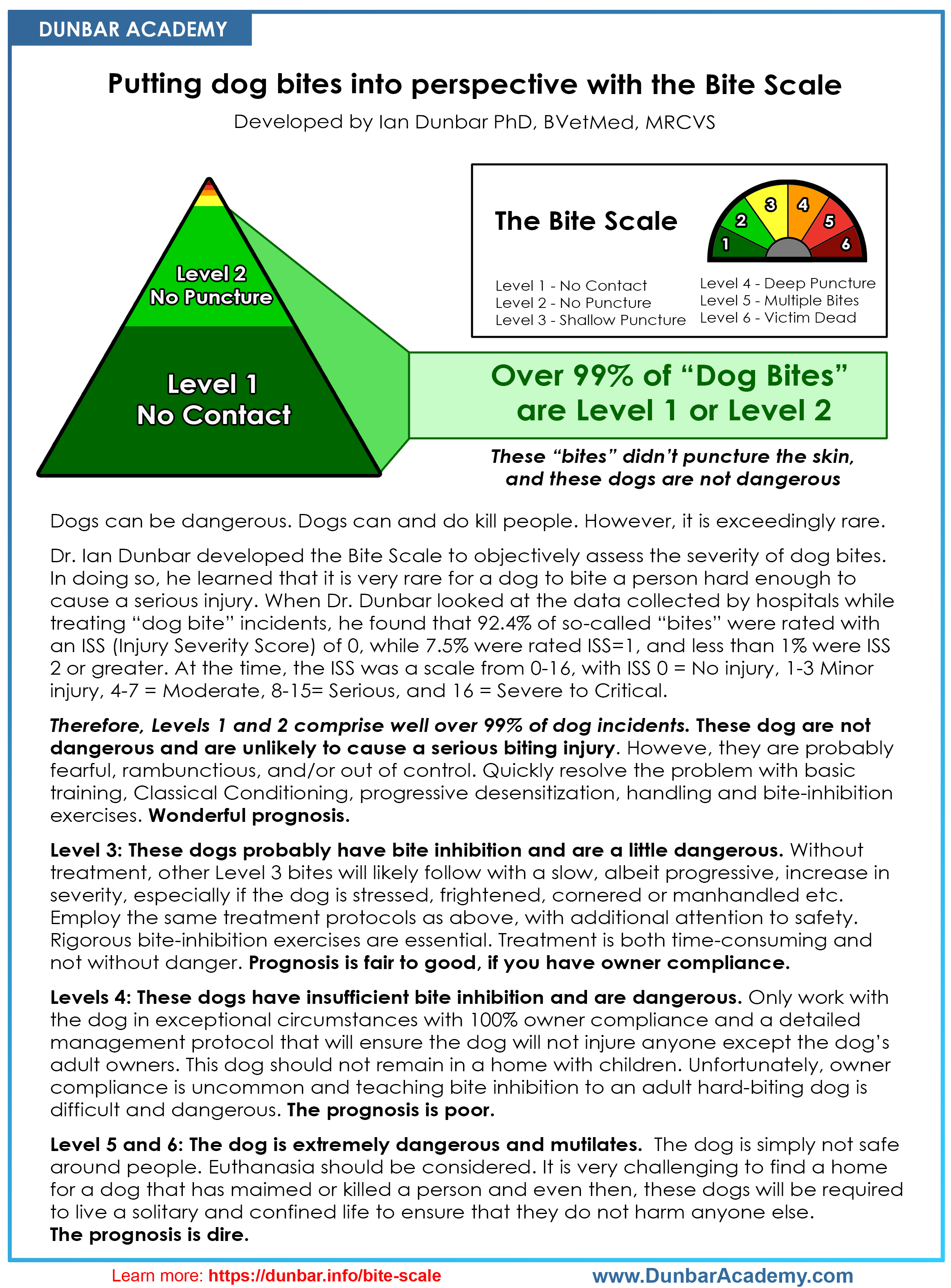
Download the PDF Version: Bite Scale Perspective.pdf
To objectively evaluate bite severity, Dr. Ian Dunbar developed the Bite Scale.
The scale classifies bites based on the amount of damage caused.
Level 1
No skin contact.
Level 2
Teeth touch skin but do not puncture.
Level 3
One or more shallow punctures.
Level 4
Deep punctures and significant tissue damage.
Level 5
Multiple serious bites.
Level 6
Victim dead.
This distinction matters because behavior may look alarming while still causing little or no injury.
Over 99% of Dog Bite Incidents Cause No Serious Injury
One of the most surprising findings from Dr. Dunbar's research is that the vast majority of so-called "dog bites" fall into Levels 1 and 2.
That means:
- No puncture wounds
- No serious injury
- No significant damage
These dogs may be upset, frightened, or out of control.
But they are not dangerous in the sense that most people imagine.
As Dr. Dunbar explains:
"The beauty, the sheer beauty of dog-dog reactivity, is that a good 97% of dogs are safe with their jaws because of bite inhibition."
Bite Inhibition Is Good News
Bite inhibition is a dog's ability to control the force of their bite. That's an incredibly important skill because dogs possess remarkably powerful jaws. If a dog truly intended to inflict serious injury, it usually could. When a dog chooses not to cause damage—even when frightened, frustrated, or highly aroused—that tells us something important about the dog's character and level of self-control.
For example:
- A dog that has been involved in several dog fights but has never seriously injured another dog
- A dog that has snapped at a person without puncturing skin
- A dog that has made contact but caused no meaningful injury
These are all signs that the dog may possess good bite inhibition.
That doesn't mean the behavior is acceptable, nor does it mean the problem should be ignored. However, it does mean the prognosis is often much better than owners realize. A reactive dog with good bite inhibition is very different from a dog that intends to cause serious harm.
Dangerous Dogs Are Different
Of course, some dogs are genuinely dangerous. Dogs that have inflicted deep puncture wounds or caused serious injuries require a very different approach. Training is typically more challenging, management becomes much more important, and the risk of future injury is significantly higher.
That is not what we're talking about here.
Most reactive dogs never cause serious damage. Most reactive dogs are not dangerous. They may bark, lunge, growl, and create a great deal of stress for their owners, but when it comes to their jaws, they continue to exercise remarkable restraint. And that's encouraging because dogs with good bite inhibition can often improve dramatically and surprisingly quickly with proper training and relatively little risk.
A Note About Bite History
A dog's previous behavior is one of the best predictors of future behavior.
If a dog has never bitten a person or been involved in a fight with another dog, it may be impossible to know with certainty what level of injury that dog would inflict if it did bite. For this reason, all dogs should be managed responsibly and introduced to new situations thoughtfully.
Dogs that have inflicted deep puncture wounds or serious injuries present significant risks and we strongly encourage individualized assessment by a qualified behavior professional.
Why This Matters for Training
Many owners avoid training because they worry their dog will hurt someone.
Ironically, that often makes the problem worse.
Fear spreads.
Triggers multiply.
The dog's world gets smaller.
As Dr. Dunbar points out:
"If the treatment is stressful, how much more stressful is not even trying to resolve this problem today?"
For dogs that are reactive but not dangerous, the opportunity is enormous.
Because these dogs have demonstrated bite inhibition, we can safely begin helping them build confidence, develop better social skills, and learn new responses around other dogs.
